
A Comprehensive Guide to Diamond Care

Diamond is considered the most durable and long-lasting natural mineral, and this property has led to its widespread use in the jewelry industry. Durability is the ability of a gemstone to resist wear, heat, and chemicals. Durability is made up of three characteristics: hardness, strength, and durability.
In short, hardness is a stone’s resistance to scratching and abrasion; strength is how resistant a stone is to breaking and chipping; and durability is how resistant a stone is to chemicals and temperature changes.
Hardness
Diamond is the hardest known natural mineral according to both the Mohs and Knoop scales. The hardness of gemstones and minerals is measured on the Mohs scale. The scale dates back to 1812, when German mineralogist Friedrich Mohs selected ten minerals and assigned them numbers based on the relative ease or difficulty with which each could be scratched by another. What the Mohs scale does not show, but is of great importance to the diamond industry, is that diamonds can scratch any of the precious metals used in jewelry. This means that if a diamond is loose in its setting, it can wear away at the setting and fall out over time. Diamond hardness is due to its very compact crystal structure. Despite its hardness, diamonds are naturally brittle and can even shatter into pieces when subjected to strong impacts.
Strength
Any gemstone, including diamonds, will break if it is placed in the wrong position or if the impact is strong enough. Strength is a measure of how well a gemstone can withstand breaking, chipping, or cracking. Diamonds are stronger in directions where their atoms are more tightly packed, and weaker where they are less tightly packed. These areas, called cleavage points, are the main source of damage in diamonds. A jeweler can best cut a diamond in the correct direction. Cutting a diamond involves splitting its crystal along one of its triangular or octahedral planes. It is interesting to note that some of the most famous historical diamonds were planned months in advance.
Durability
Durability is a term that describes how well a diamond can withstand temperature changes and chemicals. Diamonds are nearly invulnerable to most acids. The diamond cutting process generates a lot of heat, but the diamond usually remains intact and undamaged during this process. Situations that threaten the stability and durability of a diamond are sudden and large changes in temperature, which can cause thermal shock and new cracks or the expansion of existing fractures in its surface.
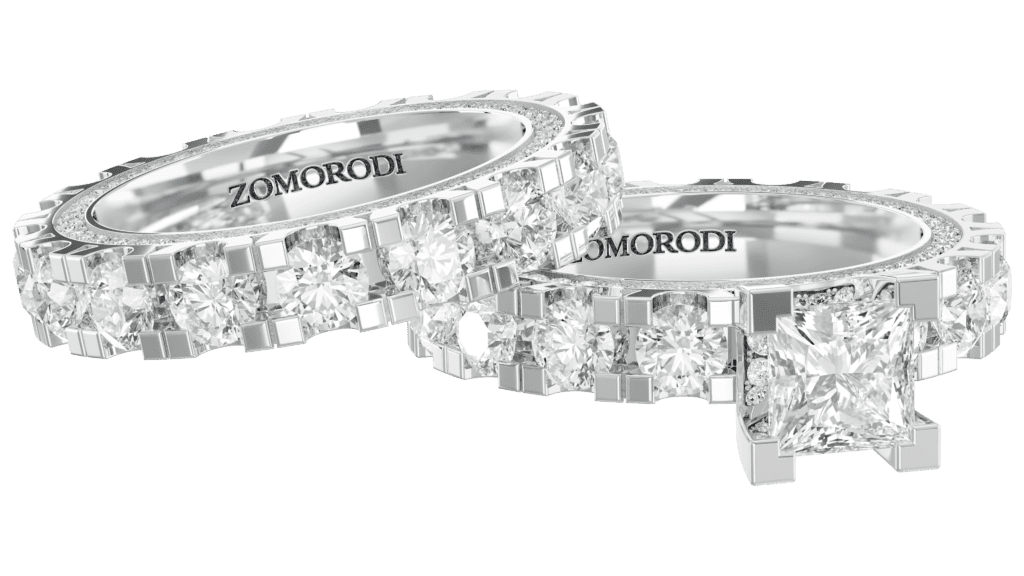
How to Minimize the Risk of Diamond Chips?
If you look at the sharp corners of a princess cut diamond or similar cut style, you can clearly see that these are the most vulnerable points. So they are often placed between prongs to protect them from chipping or chipping. Even so, a hard blow to the prongs at the corner of the diamond can cause a chip to be chipped off the side, leaving it jagged and stepped instead of smooth and polished.
A chipped part of the stone usually occurs when the girdle (Persian edge) or another point of the diamond hits something hard or hard. Collisions with bathroom, kitchen and bedroom cabinets, or when jewelry and watches are placed together are the most common causes of diamond chipping.
To minimize damage, here are some tips:
1. Be careful not to let your diamond hit sharp objects.
Regardless of size or cut, a diamond is more likely to chip or chip if it is exposed to sharp objects. A new technique for cutting diamonds called chamfering is being used by some in the diamond trade and is believed to improve the durability of cuts like princess cuts. Chamfering means cutting a very small, flat surface off each corner.
2. Protect the culet.
In the past, almost all diamond cuts had a small extra facet cut at the end to protect it from chipping. Cuts that reach a sharp point and have more vulnerable points have been popular, so they are protected by prongs to reduce the chance of damage to the prongs. V-shaped, bezel, or semi-bezel prongs protect the corners of the stone well.
3. Buy a diamond with a wider Persian edge (girdle).
Since a hard blow can damage the diamond’s edge (girdle), it is a given that a thicker belt is less likely to break. Belts with very thin facets are at much greater risk of damage.
4. Check the condition of the prongs from time to time.
One of the most common reasons for a diamond to become chipped is if the prongs holding it in place are broken. If the diamond is loose in its setting, it is at greater risk of shattering. Even if just one prong is damaged, your diamond will no longer be securely in place.
5. Do not use a diamond that is cracked or chipped.
If you think that a diamond that is already cracked or chipped is safe after being placed in the prongs, you are wrong! In fact, the crack in the diamond can get bigger and break more severely.
In short, there is no such thing as absolute hardness. Diamonds are very hard, but remember that if a jeweler can intentionally break and chip a diamond with a blow in the right direction, it is possible that you could accidentally break it or damage the diamond with a blow.

Cleaning Diamonds
Since diamonds attract dust, they need to be cleaned from time to time. Chlorine-based detergents, hairsprays and dyes, lotions, soaps, body sweat, and natural skin oils can also cause a layer of grime to form on the diamond’s surface, dulling its shine and luster.
Use the following tips to keep your diamond looking its best:
To clean your diamond at home, first make a cleaning solution.
The contents of this solution are 1/2 cup of warm water and 1/2 cup of glass cleaner. Now wet your jewelry with lukewarm water. Then, dip a very soft toothbrush into the solution and gently move it between all parts. After that, rinse your jewelry with water and dry it well so that it does not irritate or cause allergies in your skin.
Buy special jewelry cleaning cloths.
There are special cloths that are specifically designed for cleaning gold and jewelry, and they can be purchased from gold galleries or jewelry stores. The feature of these cloths is that they are very soft and do not damage the metal or precious stones, and at the same time, they can restore the shine of the stones. Note that after using the cloth, place it in a closed container to prevent any dirt and dust from entering the container. Otherwise, it may cause small scratches on the gold or stones next time.
Use commercial jewelry cleaning solutions.
You can find jewelry cleaning solutions in the market. These cleaners contain ammonium or very weak liquid soap. If you put your jewelry in it for thirty minutes, the shine and shine of the diamond will be restored to a great extent.
Go to a jewelry store.
If you think it is difficult to clean your jewelry at home, you can visit a nearby jewelry store and have them do the work. The jeweler will do it for you with minimal risk. Industrial methods such as powder cleaners, ultrasonic cleaners, and steam cleaners may be required to clean the stones.