
All about the GIA grading system
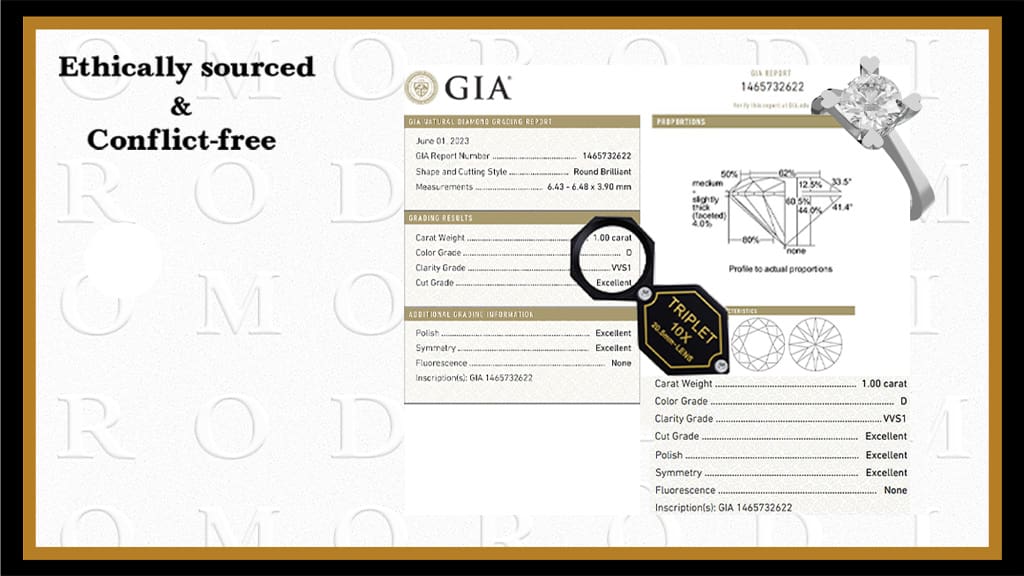
An Overview of the GIA Grading System
The “4Cs”—Color, Clarity, Cut, and Carat—are the foundation of an international grading system and standard that GIA introduced in 1950, known as the “GIA Cut Grading System.” This system was endorsed in 2005 by thousands of retailers, manufacturers, and the general public who knew diamonds well, making it easier for us to determine the quality of a diamond’s cut today.
But what is the history of this grading system?
Before 1940, there were no standards or criteria for determining and evaluating these factors, and in fact, the value of a diamond. But if we go back to 1500, numerous and variable criteria and factors were introduced in relation to measuring the quality and grading of a diamond. The terms “flawless” and “flawed” were used to assess the clarity of a diamond, “tint” or “tint” was used to assess the color, and “fine” and “poor” were used to measure the quality of its cut. “Carat” is the only term used to describe weight that has been used since 1500. These changes in names and terminology made it difficult for jewelers to communicate with their customers. It was not easy for jewelers to convey the values and criteria important to the measurement of diamonds to buyers, and it was even difficult for customers to remember these terms and criteria. In the early 20th century, Robert M. Shipley, a veteran jeweler, took on the task of specializing the jewelry industry in America. To this end, he founded the GIA to provide formal, conventional gemological instruction to aspiring jewelers. Shipley also founded the American Gemological Society (AGS), a professional association whose members were GIA graduates.
Shipley established a standard for diamond grading terminology, which included color, clarity, cut, and carat weight, or the “4Cs.” The 4Cs then became an easy-to-remember system for explaining diamond grading criteria to students and gemologists.
Under Shipley’s leadership, the refinement of the 4Cs became the vernacular of GIA’s classrooms and a way to attract retailers and jewelers to GIA.

Cut: One of the Most Important Factors in Diamond Evaluation
Carat, color, clarity, and price are factors that help us choose the diamond of our choice; but the importance of the quality of the diamond’s cut – how the facets and angles of the stone are cut and polished – may not be easily recognized in its appearance.
In general, the more brilliant the diamond, the higher its ranking. The reflection of light in an attractive and captivating diamond should be uniform and balanced. Obviously, well-cut diamonds are more brilliant than diamonds that are not well-cut, even if they are equal in size, color, and clarity.
According to research and conclusions from the GIA Institute, cut is the most important factor in the visual appeal of a diamond. The brilliance and clarity of a diamond, especially when viewed from above, have a great impact on its appearance.
The GIA provides cut quality grades only for standard brilliant-cut diamonds that fall within the D-Z color range. The D-Z range is the broadest grading range for colored diamonds. The brilliance, luster, weight ratio, durability, polish, clarity, and symmetry of the diamond are all considered in this final cut quality assessment.
There are five levels in this scale:
Excellent (EX), Very Good (VG), Good (G), Fair (F) and Poor (P)
A diamond with an EX cut is very brilliant. An EX diamond has a uniform pattern with clear contrast between dark and light areas, resulting in a balanced and clear reflection of light. Good light reflection and contrast indicate that the diamond is perfectly cut. A G-grade diamond is not as clear and brilliant as an EX-grade diamond; the reflection of light in this stone is not as clear and the diamond appears dull and dark. A diamond with a grade of (P) is darker and duller than the other grades. Most people choose between (EX) and (VG) diamonds.
The word “cut” has a meaning beyond the cut of a gem; in addition to its appearance, the cut is also a testament to the factors that determine the quality of the gem.
The quality of a gem’s cut shows how the gem was produced or how its facets were finished. Although the quality of a diamond is mixed with the way and delicacy of the cut, its polish, symmetry and clarity, its visual beauty also depends on the way light passes and refracts through it. For example, a raw and natural ruby or ruby that is saturated with red and without impurities will present a beautiful and eye-catching appearance when magnified less than 10 times, even though its finishing and polishing are poor. However, if its cutting causes excessive scratching and the loss of the saturated red color, the ruby cutting project has failed!
The cut of a diamond is the most important factor in determining the amount of dispersion (the reflection of white light and its conversion into all the colors of the rainbow), brilliance (the internal and external white light reflected by the diamond), and luster (the amount of shine a diamond produces and the bright and dark areas created by reflection within the diamond). The type of cut of this gemstone is another important characteristic that actually determines its appearance. Diamonds are cut according to the tastes of gold and jewelry lovers and the trends in this field. The reputation of a diamond depends on how it is cut, each cut has its own special name. Among the various diamond cuts, the round cut, known as the brilliant, is the most popular and is the most commonly used stone in rings and jewelry rings. Other famous cuts include Marquise, Teardrop, Heart, Radiant, Princess, Emerald, and …

Diamond Weight
Diamond weight is measured in carats. The standard unit of weight used for gemstones; a carat is 0.2 grams or 200 milligrams. The higher the carat, the rarer and more valuable the diamond, so the more valuable the diamond ring will be. But you might be interested to know where the word “carat” comes from? The word “carat” is originally derived from the seeds of a medicinal plant called carob. In the past, carob seeds were used as weights because of their uniform size. The carat weight became standard at 0.2 grams in the early 20th century.
Diamond Color
Diamonds come in all colors. White diamonds range from colorless, which is the purest, rarest, and most valuable, to varying degrees of yellow. Diamonds are graded on a color scale from D (colorless) to Z (intensely colored). The color of a diamond is assessed based on the absence of color.
A diamond that is chemically, structurally, and structurally free of color is worth more. The GIA D-Z diamond color grading scale is the most widely accepted industry grading system. The scale starts with the letter D, indicating colorless, and continues with increasing color to the letter Z. The D-Z range is the broadest grading range for colored diamonds, but diamonds come in all shades of the rainbow. For naturally colored diamonds, blue, green, orange, and red are the rarest, and yellow and brown are the most common.
White diamonds are graded and valued based on the absence of color, while fancy colored diamonds are valued based on the presence of color. Shades that are deep and distinct are worth more than shades that are weak or pale. Even very slight differences in color can have a big impact on the value of a diamond ring.

Diamond Clarity
Diamond clarity is a measure of the presence of natural inclusions or flaws in a diamond.
Evaluating diamond clarity involves determining the number, size, prominence, nature, and location of these features, as well as how they affect the overall appearance of the stone. Many blemishes and blemishes are so small that they are invisible to anyone except a trained diamond cutter.
To the naked eye, a VS1 diamond and an SI2 diamond may appear identical, but they are different in quality. The more flawless a diamond is, with no flaws or extraneous inclusions visible under a jeweler’s loupe, the rarer it is and the more valuable the diamond ring will be.
Diamond clarity is graded from F (flawless), which is the rarest and most rare, to I (flawless).
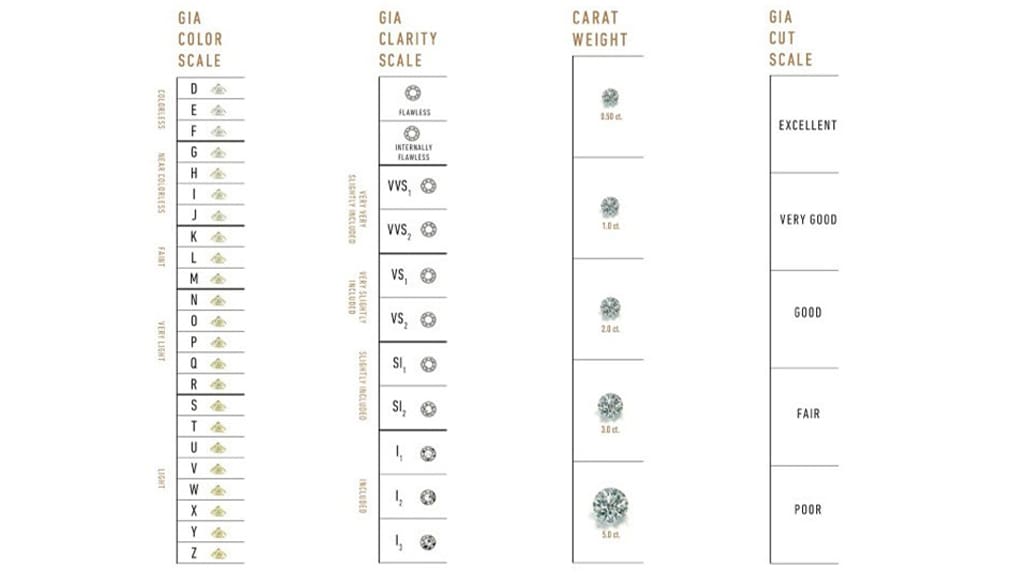
If the jewelry item you purchase contains GIA-certified diamonds, you will also receive a certificate of authenticity with the jewelry item. All of the above information and specifications about the diamond are listed on the certificate.
Ultimately, your personal taste is the most important factor in understanding the brilliance and beauty of a diamond. While diamonds are some of the most brilliant and enduring items to enhance your style, it is you who gives them meaning.